Tuesday, September 24, 2013

Johnny Ryan


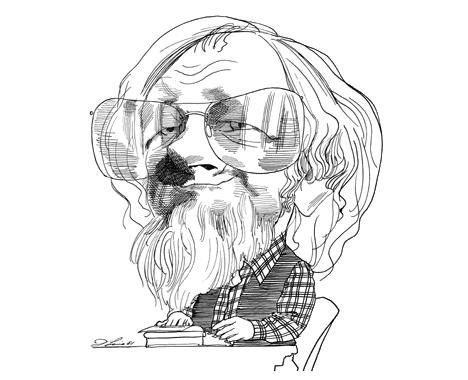
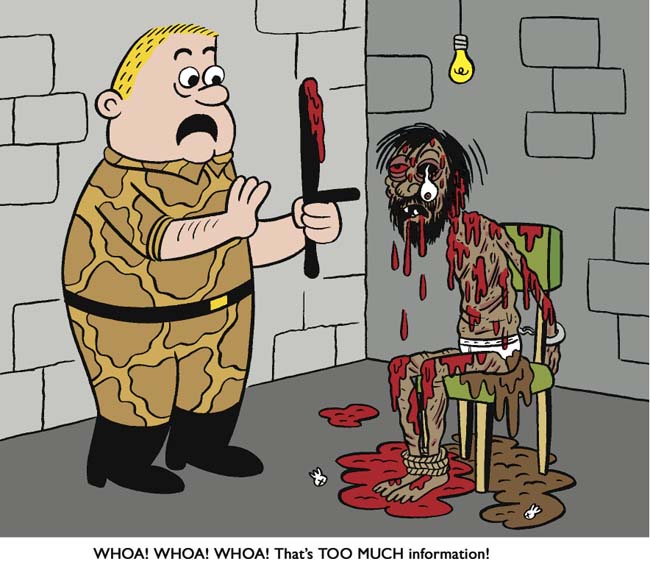
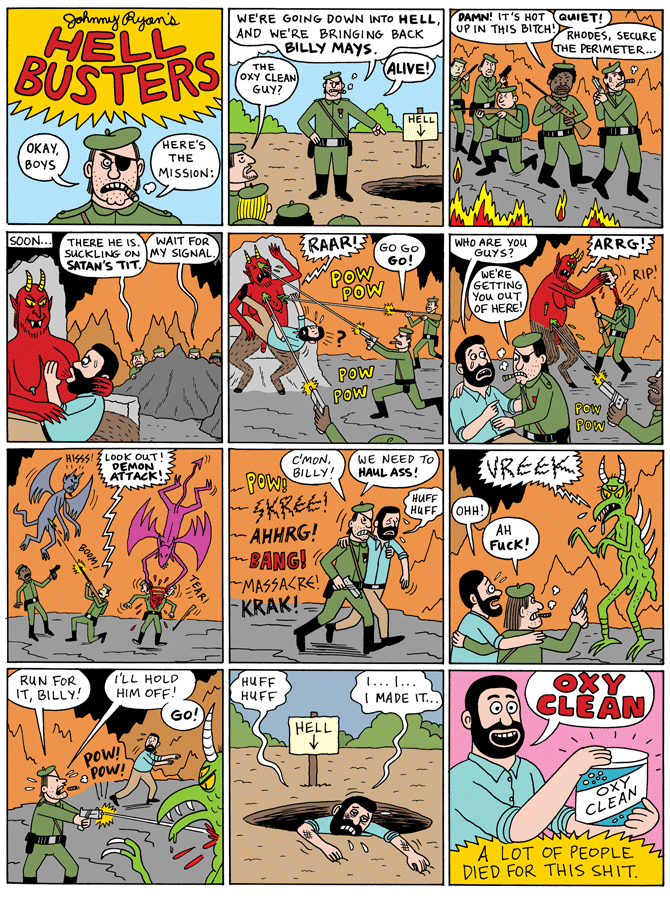
A friend of mine recently turned me on (hehe) to a cartoonist named Johnny Ryan, creator of the Angry Youth Comix and Blecky Yuckerella series put out by Seattle-based, alternative comic publisher, Fantagraphics Books. I started my post with the particular comic seen above because I feel like it is a fair representation of his work: crudely drawn, crude in general, always offensive, frequently scatological, obscene, racist (and, in any comic that features a woman, quite sexist). And that's the point. The cartoonist equivalent of a shock-jock, his body of work is united by a singular vision: to be as politically incorrect as possible, to force a confrontation with that which we'd rather not talk about. Here's a picture of the maestro himself, which offers a window into (the sick, twisted and provocative) mind of the creator:


It's in this urge to provoke that I find common ground with Ryan. I think that truth emerges through balanced discourse and I find most proponents of political correctness self-righteous almost to the point of absurdity. In their fervor, they make mockeries of themselves, just like his work, in it's general irreverence, makes a mockery of the issues that they so (pseudo-)sanctimoniously maintain to be untouchable. His comics are intended to shock, to draw out scandalized reactions from the reader, to make old ladies faint. In that way, Ryan's work help brings a sense of balance to the spectrum of political correctness by firmly anchoring the extreme contrarian arguments against the concept in the shit filled waters of dumb blonde/racist/dead baby jokes (in a way that people who make those jokes without a sense of irony could never do). In that sense, he opens open new channels of discourse through edgy provocation, by not just saying what no cultured individual with any sense of propriety would ever dare to say, but by illustrating such superficially horrendous sentiments in such a child-like fashion! 

He is not for everyone, but I  for one commiserate with the vitriolic undercurrents that permeate the majority his work. He unabashedly spits in the face of the socially accepted, hypocritically "polite" social discourse so prevalent today, the well-worn political vagueries and go to platitudes used so readily by so many. His work is the discoursal equivalent of pulling up the rug after years of (willingly) sweeping that which we'd rather not talk about (openly) under it. 


Word of the Day: Potvaliancy

My word of the day email provided me with a chuckle today. The word in question? "Potvaliancy", which means, "courage or bravery occasioned by drunkenness". I think that "Prince Potvaliant" would have been an appropriate nickname for me during undergrad (and maybe a few of the following years…). I am pleased by the existence of this word. 


Sunday, April 21, 2013

The Maunsell Sea Forts


This is not going to be a very deep post. No introspective search for universal truths, no musing on aesthetics and beauty. I just want to share something that I find infinitely curious: the history and continued existence of the Maunsell Sea Forts, current home of the principality of Sealand, former Pirate DJ haunt and the proof that sometimes the truth is stranger than fiction. I really wish I could make this stuff up.


Built during World War II by the British government to deter further intrusion by elements of the German Kriegsmarine and as anti-aircraft platforms to aide in the fight against the Luftwaffe, they were then decommissioned during the 1950s and apparently left to rust, rot and interfere with shipping (they've caused multiple shipwrecks). 


Since then, they've housed rogue 'pirate' DJs (those crazy, trendsetter 'hepcats' whose only sin was a desire to share broadcasts of the newest, grooviest rock n' roll tunes that had been banned on land by the likes of a list of self proud town mice...(pigs)), a rather ingenious reappropriation. They are also the current home to the Principality of Sealand, the self-proclaimed, "smallest nation in the world." Again, I wish I could make stuff like this up. For more information, consult the Principality of Sealand's official website here.


One final note: the journeyman fiction writer in me just drools at the prospect of including these forts into a post-apocalyptic/dystopic tale. In her "MaddAddam" trilogy, Margaret Atwood makes mention of one of the protagonists, Jimmy, explores a couple of off-shore structures, scavenging for food and other survival items in the wake of the "waterless flood". I don't know what she had in mind, but I couldn't help but project the image of the Maunsell forts onto the book.

To me these structures seem like the perfect destination to weather out a plague or nuclear conflict. I've also got the image of a hoard of zombie swimmers thrashing through the Themes estuary to encircle a band of resourceful survivors who've made it to the forts and now take in the scene by torchlight. Oh, the possibilities! 

Saturday, April 20, 2013

Blancanieves


I saw a beautiful film today called "Blancanieves" (which is the Spanish translation of 'Snow White'). It was shown as part of the 2013 'Ebertfest' film festival here in Champaign, Illinois. Going into the movie, I was a little skeptical because the only thing I knew about it was that it was an 100 + minute silent film in black and white. I feel like that's enough to make even (hardcore) (amateur) film buffs (like myself) get a little antsy. But, it was being shown in the recently renovated Virginia Theater, an old movie hall from the 1920's, complete with organ, ornately decorated balconies and intricate murals depicting muses, great artists and other artistic inspiration scrawled across the ceiling, and so ultimately, my curiosity, about the movie and the interior of the Virginia, provided sufficient impetus. As it turns out, it would the perfect place to watch a film like this and the perfect way to frame this particular experience.


Written and directed by Basque filmmaker Pablo Berger, "Blancanieves" is a homage to the timelessness of fairy tales and the silent films popular around the time of the Virginia's construction. Sr. Berger combines these two elements to create a base story that he uses to create a foundation from which he creates a very Spanish tale about bullfighting and redemption. The (almost) personal nature of the storyline, as well as nods to Spanish culture and the full spectra of emotions exhibited by the characters induce in viewers the feeling that this is an intimate and lovingly created work,  a view readily expressed/confirmed by the writer/director. It is a little too long but you get the sense that it has been cut down to what Berger believes to be it's absolute core and that the doting director may not be willing to let anything else go. In his pre-film introduction speech, he admitted to the audience that the movie had taken him eight years (as well as the loss of much of his hair (sacrificial offering?)) to create. As far as I'm concerned, it was well-worth the extraordinary effort. 

I won't talk much about the movies plot because any written recap of it wouldn't do the film justice. It has to be seen to be fully appreciated. It is a silent film after all; by definition, it must be seen to be understood.

 Instead, I'll share another anecdote from the screening: right before the film began, the director ended his speech by imploring everyone in the audience to turn off our phones and let ourselves be immersed in the experience because, in his words,  "...to see a film is to live the life of another person, to dream while awake". He ended his speech by wishing us, "happy dreams and sweet nightmares".  


A few thoughts I will share: I thought the film was perfectly cast. It is filled with actors who belong in a silent film, performers who are not limited (but liberated, almost) by the lack of dialogue.  Maribel Verdu (the nurse from "Pan's Labyrinth) embraced the role of the evil stepmother to delicious, almost eery perfection. Similarly brilliant/beautiful was Macarena Garcia's eager, emotive, energetic, youthful and full-hearted take on the titular character. And since I have a special place in my heart for memorable faces/particularly well-cast character roles and actors (I call it the "Steve Buscemi Zone"), I'd be remiss not to offer a tip of my cap to Josep Maria Pou, in the role of "Don Carlos", the sinister and manipulative bull fighting agent, a small but ultimately pivotal role. And it is truly amazing the range of emotions that Daniel Gimenez Cacho, as renowned bullfighter "Antonio Villalta", is able to express with just his eyes. 


The last thing I want to comment is Berger's use of the antiquated medium of black and white film. I Through his choice of medium, he makes us realize the beauty of light and the vital role that it (and it's manipulation) plays in creating something that is visually arresting. "Blancanieves" is a tribute to the beauty of light. The film's silvery monochrome glows and glitters, alleviating and helping set the tone for the film's many joyous moments. It's foils, shadow and darkness, play an equally important role: menacing, consuming, drawing the audience into the characters' moments of despair and melancholy.

It's kind of ironic, actually: by eliminating color, Berger allows us to literally "see the light" in all it's glorious radiance. As such, the nuances of illumination help create an extra element, a meaning-carrying component of the film that is an indispensable element of it's character. 

Here is the trailer.  Watch it with the knowledge that it does the full film little justice. Hopefully it will pique your curiosity, at least. If it does, go see the film and give yourself over to a waking dream. 

Friday, April 19, 2013

Cormac McCarthy (via his alter ego, Cornelius Suttree) on What it Means to be Human


As I watched the news coverage of the manhunt for Dzokhar Tsarnaev today, I had to turn off the TV. The 'news' coverage, apocryphal stories that couldn't seem to keep up with social media coverage of the situation, really little more than overeager speculation and, in some cases, outright misinformation, got my own mental gears grinding and I started to speculate, too. My head was filled with questions like: Was this whole thing a grand conspiracy, a false flag operation perpetrated on the American people by it's sworn protectors? And would they ever even find him? If so, would they take him alive? Or would he be killed in a fire fight, blown to bits by one of his home made explosives or riddled with bullets by cops running on adrenaline and pulling the trigger reflexively, more muscle memory than volition? Would we ever know the (true) motives behind the Boston Marathon Bombings?

And then, my eager desire to find answers to these questions was transformed into the sobering realization that this morbid curiosity was kind of depressing, sick, even, like salivating over a play-by-play broadcast of an execution.

"Now, the doctor is sanitizing the needle. The condemned man lays strapped to the operating table, breathing normally, resigned to his fate."

(Now, after he's been caught, as I peruse all the social media output (Twitter, Facebook, etc.) related to the event, I find myself even more sickened to see how happy everyone is at the news of his capture because so many people don't really seem to be happy that further bloodshed has been avoided. They seem happy that now he will be made to stand trial and he will probably be killed for what he and his brother did. How is more killing an answer to anything? Why are we so eager to judge others? Why don't we try and empathize? I pray for compassion but I've a sneaking suspicious that my plea will fall on deaf ears.

And I remember a quote from a certain sagacious and enigmatic wizard: "Many that live deserve death. And some that die deserve life. Can you give it to them? Then do not be too eager to deal out death in judgement. For even the wise cannot see all ends."

Yes, Gandalf is a fictional creation, but his existence was conjured up by a man who'd seen humanity at it's absolute worst. Tolkien had been in the trenches at the Somme, a battle during World War One that caused more than a million casualties over the course of a four and half month span. I think that qualifies him as an 'expert' when it comes to explaining the role that compassion plays in defining what it means to be human because he witnessed the catastrophic consequences of divorcing that component from our operational motives).


This initial set of realizations were followed closely by another, even more terrible one: even if we do find out why all of this happened, it's just one example (out of the thousands and millions that have taken place throughout history) of man's cruelty towards his fellow man, of our capacity to do such damage to one another. Some people just seem incapable of tending to that 'spark' of life inside each one of us. Instead of cupping it and stoking the fire, occasionally blowing on it or adding more kindling, fostering a controlled burn that will last throughout the night, they let it ignite some vast reservoir of hate or frustration or anger or madness that rages out of control and ends up consuming them whole, a microcosmic holocaust.

Sure, there are motives for each individual event but the existence of that impulse, the biological reason as to why we should desire to hurt and kill and maim and cause pain seems inexplicable to me. We are supposed to be more logical and compassionate than our animal brothers. But they kill out of necessity. If they don't, they die. But we seem very capable of consciously choosing to kill others for motives that are very far from ensuring survival, needlessly, senselessly.

I've always felt that compassion and empathy are traits that help compose the core of what it means to be human, but events like this force me to confront the fact that many others define it in very different ways.

And the more I thought about this, the lonelier I felt. Maybe not 'lonely'. More isolated. Or exiled without knowing why or what I'd done. I looked at the situation, the facts, and thought about the little boy who was killed on Monday or about the people who were maimed or injured or even the witnesses and despite all that horrible carnage, I couldn't stop thinking about the kid who perpetrated the atrocity.

I didn't think about his motives. I thought about what it was like to be 19. I thought about how he was probably scared out of his mind (he'd witnessed his brother being shot to death not 24 hours earlier and was literally being hunted by thousands of law enforcement and military, some of whom I'm sure were very eager to avenge those killed and injured by the bomb blasts). He was all alone, hiding under a boat in some strangers backyard, not sure of how many hours he had left on this earth. I'm still amazed they were able to take him alive. My inability to think about anything but him made me feel so distant from the rest of the people watching the event, because it seemed like the polar opposite of where everyone else's hearts and minds were at.

Transitioning back to earlier in the afternoon: I walked away from the TV, closed my laptop and began a search for distraction that ended up with me opening up my copy of "Suttree" by Cormac McCarthy. I opened it to a random page and stumbled upon a conversation between the eponymous main character and an acquaintance, an itinerant 'ragpicker' (a dirty, old vagabond scavenger). Here it is:

"I seen strange things in my time. I seen that cyclome come through here where it went down in the river it dipped it dry you could see the mud and stones in the bottom of it naked and fishes layin there. It picked up folks' houses and set em down again in places where they'd never meant to live. They was mail addressed to Knoxville fell in the streets of Ringgold Georgia. I've seen all I want to see and I know all I want to know. I just look forward to death. 

He might hear you, Suttree said. 

I wisht he would, said the ragpicker. He glared out across the river with his redrimmed eyes at the town where dusk was settling in. As if death might be hiding in that quarter. 

No one wants to die. 

Shit, said the ragpicker. Here's one that's sick of liven. 

Would you give all you own?

The ragman eyed him suspiciously but he did not smile. It won't be long, he said. An old man's days are hours. 

And what happens then? 

When?

After your dead?

Dont nothin happen. You're dead. 

You told me once you believed in God. 

The old man waved his hand. Maybe, he said. I got no reason to think he believes in me. Oh I'd like to see him for a minute if I could. 

What would you say to him?

Well, I think I'd just tell him. I'd say: Wait a minute. Wait just one minute before you start in on me. Before you say anything, there's just one thing I'd like to know. And he'll say: What's that? And then I'm goin to ast him: What did you have me in that crapgame down there for anyway? I couldnt put any part of it together. 

Suttree smiled. What do you think he'll say?

The ragpicker spat and wiped his mouth. I don't believe he can answer it, he said. I dont believe there is a answer."


And I couldn't believe that it had been that page out of all the 470-plus pages that make up that book that I'd stumbled upon. I was quite literally gobsmacked. I wondered if it was a coincidence or fate or if somebody upstairs with an intimate knowledge of my proclivities felt that maybe catering to my love of literature was going to be the best way to communicate a profound message to me, to induce an epiphany about the true nature of the world in this (sometimes cynical) skeptic? 

Regardless of the real reason as to why I'd opened the book up and found that particular episode (because let's face it, it was either a coincidence or it had something to do with the way I'd bent the books spine, something mundane like that) I found comfort in what most would view to be a rather bleak passage. Well, maybe the comfort I've found is not the words of the passage, but the place they take me to.  

My interpretation of the ragpickers message is this: you can't explain somethings in life. You just can't. To borrow a cliche, the "mysteries of life" really do exist and are abundant. You have to accept this and the sooner you do, the sooner you uncover the hidden upside: just because certain things can never be known completely, that shouldn't stop you from trying to get a better understanding of them. You have to be tenacious, you have to struggle with it because just trying to understand is a form of compassion in and of itself. There is (immense) value in the attempt, to try and put yourself in the other's (metaphysical) shoes and to try and empathize with them, to understand what drove them to do something so heinous. At the very least, a little reflection, some soul searching can't hurt because it helps us to learn more about ourselves. A little nod to Socrates and that old maxim: nosce te ipsum. In knowing ourselves better, we become better prepared to understand others and I believe the more we try and understand others, the more we can focus on our similarities, on that which unites and brings us together (and there is so much of that). If we can adopt the attitude that we are in this struggle together, striving for the light instead of wallowing and/or dragging one another down back into the darkness, maybe we'll be more inclined to try to help one another. That is my hope, at least.

I'm inclined to believe that once you get past the almost hip/style nihilistic ennui, Thom Yorke would agree with me. Then again, maybe not.

So, while it is not the same thing as being able to hug the people I love and tell them I love them face-to-face (very far from it, actually), Cormac McCarthy-cum-Cornelius Suttree was able to comfort me and help me during a moment of grave doubt in humanity. In reappropriating (and reinterpreting) his work,  I have yet another reason to be grateful to him for sharing his writing with the world. 

Monday, January 21, 2013

The School


A short story by Donald Barthleme, taken from his collection, "Sixty Stories"

Well, we had all these children out planting trees, see, because we figured that ... that was part of their education, to see how, you know, the root systems ... and also the sense of responsibility, taking care of things, being individually responsible. You know what I mean. And the trees all died. They were orange trees. I don’t know why they died, they just died. Something wrong with the soil possibly or maybe the stuff we got from the nursery wasn’t the best. We complained about it. So we’ve got thirty kids there, each kid had his or her own little tree to plant and we’ve got these thirty dead trees. All these kids looking at these little brown sticks, it was depressing.

It wouldn’t have been so bad except that just a couple of weeks before the thing with the trees, the snakes all died. But I think that the snakes – well, the reason that the snakes kicked off was that ... you remember, the boiler was shut off for four days because of the strike, and that was explicable. It was something you could explain to the kids because of the strike. I mean, none of their parents would let them cross the picket line and they knew there was a strike going on and what it meant. So when things got started up again and we found the snakes they weren’t too disturbed.

With the herb gardens it was probably a case of overwatering, and at least now they know not to overwater. The children were very conscientious with the herb gardens and some of them probably ... you know, slipped them a little extra water when we weren’t looking. Or maybe ... well, I don’t like to think about sabotage, although it did occur to us. I mean, it was something that crossed our minds. We were thinking that way probably because before that the gerbils had died, and the white mice had died, and the salamander ... well, now they know not to carry them around in plastic bags.

Of course we expected the tropical fish to die, that was no surprise. Those numbers, you look at them crooked and they’re belly-up on the surface. But the lesson plan called for a tropical fish input at that point, there was nothing we could do, it happens every year, you just have to hurry past it.

We weren’t even supposed to have a puppy.

We weren’t even supposed to have one, it was just a puppy the Murdoch girl found under a Gristede’s truck one day and she was afraid the truck would run over it when the driver had finished making his delivery, so she stuck it in her knapsack and brought it to the school with her. So we had this puppy. As soon as I saw the puppy I thought, Oh Christ, I bet it will live for about two weeks and then... And that’s what it did. It wasn’t supposed to be in the classroom at all, there’s some kind of regulation about it, but you can’t tell them they can’t have a puppy when the puppy is already there, right in front of them, running around on the floor and yap yap yapping. They named it Edgar – that is, they named it after me. They had a lot of fun running after it and yelling, “Here, Edgar! Nice Edgar!” Then they’d laugh like hell. They enjoyed the ambiguity. I enjoyed it myself. I don’t mind being kidded. They made a little house for it in the supply closet and all that. I don’t know what it died of. Distemper, I guess. It probably hadn’t had any shots. I got it out of there before the kids got to school. I checked the supply closet each morning, routinely, because I knew what was going to happen. I gave it to the custodian.

And then there was this Korean orphan that the class adopted through the Help the Children program, all the kids brought in a quarter a month, that was the idea. It was an unfortunate thing, the kid’s name was Kim and maybe we adopted him too late or something. The cause of death was not stated in the letter we got, they suggested we adopt another child instead and sent us some interesting case histories, but we didn’t have the heart. The class took it pretty hard, they began (I think, nobody ever said anything to me directly) to feel that maybe there was something wrong with the school. But I don’t think there’s anything wrong with the school, particularly, I’ve seen better and I’ve seen worse. It was just a run of bad luck. We had an extraordinary number of parents passing away, for instance. There were I think two heart attacks and two suicides, one drowning, and four killed together in a car accident. One stroke. And we had the usual heavy mortality rate among the grandparents, or maybe it was heavier this year, it seemed so. And finally the tragedy.

The tragedy occurred when Matthew Wein and Tony Mavrogordo were playing over where they’re excavating for the new federal office building. There were all these big wooden beams stacked, you know, at the edge of the excavation. There’s a court case coming out of that, the parents are claiming that the beams were poorly stacked. I don’t know what’s true and what’s not. It’s been a strange year.

I forgot to mention Billy Brandt’s father who was knifed fatally when he grappled with a masked intruder in his home.

One day, we had a discussion in class. They asked me, where did they go? The trees, the salamander, the tropical fish, Edgar, the poppas and mommas, Matthew and Tony, where did they go? And I said, I don’t know, I don’t know. And they said, who knows? and I said, nobody knows. And they said, is death that which gives meaning to life? And I said no, life is that which gives meaning to life. Then they said, but isn’t death, considered as a fundamental datum, the means by which the taken-for-granted mundanity of the everyday may be transcended in the direction of –
I said, yes, maybe.
They said, we don’t like it.
I said, that’s sound.
They said, it’s a bloody shame!
I said, it is.
They said, will you make love now with Helen (our teaching assistant) so that we can see how it is done? We know you like Helen.
I do like Helen but I said that I would not.
We’ve heard so much about it, they said, but we’ve never seen it.
I said I would be fired and that it was never, or almost never, done as a demonstration. Helen looked out the window.

They said, please, please make love with Helen, we require an assertion of value, we are frightened.
I said that they shouldn’t be frightened (although I am often frightened) and that there was value everywhere.

Helen came and embraced me. I kissed her a few times on the brow. We held each other. The children were excited. Then there was a knock on the door, I opened the door, and the new gerbil walked in. The children cheered wildly.

Wednesday, November 28, 2012

Grizzly Bear + Trippy Claymation = Boss!


I've been getting into Grizzly Bear more and more these days. It's a new sound for me, something I think the hyper-genre-izationalists are referring to as "psychedelic chamber pop", which actually does a half-way decent job of indicating what a lot of the stuff put out by these guys sounds like. What can I say, I'm a sucker for lots of vocal harmonies, especially plaintive, melancholic and/or dolorous vocal harmonies. This video and it's terrifying, strangely comic ingenuity helped hooked me. The song, "Ready, Able" makes me think of Pink Floyd's "Echoes" at times, which is about the highest compliment I can give to a song or band.